

Ever noticed that when you have swags of time to complete a task then it takes much more time to get to your desired end result than is necessary?
I’m aware of a similar phenomenon with money.
For example, when I have my mortgage or health insurance debited from an account before funds are paid through to me, it’s amazing how that amount is not missed and I easily live with only the amount that I receive.
Yet when my total funds are made available to me first, how hard is it to pool the amount needed to pay that mortgage and insurance?
The thoughts in my mind and the gift that is my life, are not unlike those two scenarios.
 When I leave such vacuums in my mind and my life, they will be filled for me. Moment by moment and usually with other people’s agendas.
My points of focus are then not my own.
The distractions that can fill those voids are endless.
To experience fewer of those distractions in our life, the first thing to work on is the question, “What end result do you want?”
This one question can be such a struggle for many people.
In fact, some people never begin because they cannot answer that question, not recognizing that working on that question will crystallize your vision.
Often the initial responses to this question are, what we think that others think that we should want for ourselves.
Sometimes the answer is even what ‘we think’ that we think we want!
If I can give no authentic response to that question then I must be living from someone else’s agenda. It cannot be any other way.
When there’s no mental image of an end goal... expect total confusion! -Thea Westra Share on XMy thoughts and activities cannot have been allocated a specific focus if I find myself aimlessly bobbing on the waves.
My mind operates like a filter and also as radar. With all the stimulus coming at me then what is my brain filtering out and on what is my mind focused?
If I feel that I have fewer options in life and am experiencing overwhelm then I have not got clear with what I really want and my life will be an expression of survival or chaos.
 I am much more inspired when firmly grounding my goals in what I want and where I ultimately want to go rather than basing my goals on what I already have or what I have already done.
The other thing to recognize here, is that there is no right or wrong answer to the question, “What end result do you want?”.
There is also not always a single answer nor multiple answers. That is completely personal.
How do you come about the answers for you?
One useful way to begin is to stop asking yourself, “What should I do?” and instead ask, “What would I like the end result to be?”
Those are very different questions.
“What should I do?” can immediately bring in obligations, expectations and other people’s opinions. “What would I like the end result to be?” puts the focus back on you.
When you stop asking what you should do, you may finally hear what you want to do. -Thea Westra Share on XYou might begin with something very simple.
What would you like your work life to look like?
What would you like your relationships to feel like?
How would you like to use your time?
What would you like to experience more often?
What would you like to have completed?
What would you like to have learned?
What would you like to contribute?
You don’t need to have all the answers. One genuine answer can be enough to give your thoughts somewhere useful to go.
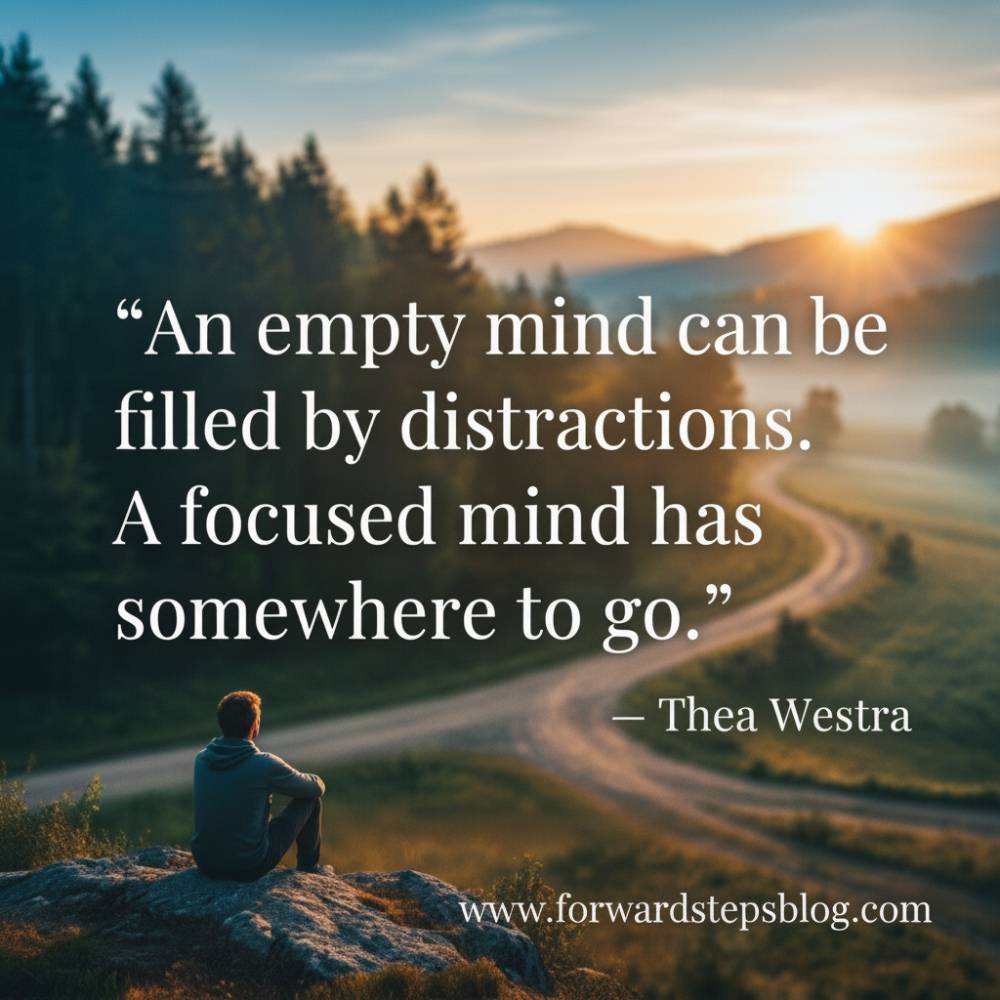 Once you have even a rough picture of an end result, you can begin asking a much more useful question, “What is one step I could take towards that?”
There are a myriad of ways to get access to what touches your heart and what would fulfill your life.
It’s one of the reasons that I load up your 365 Forward Steps Notes with so many “aha triggers” for you.
Working on this question over a period allows you to set aside time for focused conversation on the topic and for exploring many avenues.
Gradually you will expose the desired outcomes that “fit like a glove” for you.
Observe life from this perspective, as quoted here below by Victor Frankl.
“View life as a series of movie frames, the ending and meaning may not be apparent until the very end of the movie and yet, each of the hundreds of individual frames has meaning within the context of the whole movie.
View your life from your funeral, looking back at your life experiences, what have you accomplished? What would you have wanted to accomplish but didn’t? What were the happy moments? What were the sad? What would you do again and what you wouldn’t?”
 Of course, an end result doesn’t have to be something as enormous as changing your whole life.
Sometimes the end result you want is much closer and more practical.
You might want to finish a particular task, have an overdue conversation, create more space in your home, improve your finances, become fitter, learn something new or simply have a more peaceful day.
The value of knowing your desired end result is that it gives your attention a destination.
Instead of being pulled in every direction by whatever happens to appear in front of you, you have something to measure your choices against.
“Does this move me towards the end result I want?” can become a surprisingly useful question.
If the answer is yes, you have a reason to continue.
If the answer is no, you have an opportunity to decide whether that activity really deserves your time.
What Kind Of End Result Do You Naturally Focus On?
The end result you have in mind can influence what you give your attention to and the choices you make along the way. This quiz gives you a simple way to consider what tends to matter most to you when you think about where you want your life to go.
You Are A Clear Direction Seeker
You are naturally drawn to having a clear destination in mind. Knowing what you want the end result to look like can help you decide what deserves your attention and what can safely be left aside.
Your challenge may be allowing yourself to define what you want based on what genuinely matters to you rather than automatically accepting someone else's idea of what your life should look like.
Have a look at the 365 Life Power Questions eBook because one carefully chosen question each day could help you see your life more clearly, act more intentionally and stop circling the same thoughts without progress.
You Are A Personal Growth Seeker
For you, the desired end result is often connected with who you become along the way. Learning, developing new abilities and understanding yourself better can be just as important as reaching the original destination.
Keep in mind that growth does not always require a dramatic change. Sometimes becoming clearer about what you want is itself an important step forward.
If thoughtful questions help you grow, the 365 Life Power Questions eBook gives you one carefully chosen question each day to help you see your life more clearly, act more intentionally and stop circling the same thoughts without progress.
You Are A Connection-Focused Seeker
You tend to measure a worthwhile end result partly by how it fits with the people and relationships that matter to you. A goal can lose some of its appeal if achieving it means losing sight of the connections that give your life meaning.
Your clarity may come from asking not only "What do I want?" but also "Who and what do I want this life to include?"
The 365 Life Power Questions eBook could give you a useful question for that kind of reflection every day, helping you see your life more clearly, act more intentionally and stop circling the same thoughts without progress.
You Are A Fulfilment Seeker
You are naturally interested in what makes life feel worthwhile rather than simply collecting achievements. The end result you want needs to connect with a sense of satisfaction, enjoyment or meaning.
This can be a useful reminder that there is no universal right answer to the question of what you want. Your desired outcome is personal and it needs to fit your own life.
For another simple way to keep that personal clarity growing, visit the 365 Life Power Questions eBook and give yourself one carefully chosen question each day to help you see your life more clearly, act more intentionally and stop circling the same thoughts without progress.
Explore This Idea Further
Optional prompts to help you make the ideas your own.
I use AI as a thinking companion, not as a replacement for my own thinking. These prompts are simply another way to explore the ideas in this article and see how they might apply to your own life.
You don’t have to use AI to benefit from them. You can copy a prompt into a notebook, write about it in your journal, talk it through with someone you trust or simply sit with the question and see what comes up for you. If you do use ChatGPT or another AI tool, treat its responses as a starting point for your own thinking.
You remain the person who decides what is useful and right for your life.
How to use these prompts: Choose the one that appeals to you, copy the complete prompt and paste it into ChatGPT or another AI tool. You can answer its questions and continue the conversation as you go.
1. Apply This To My Life
Use this prompt when you want to connect the article’s ideas about your desired end result with something happening in your own life.
I’ve just read the Forward Steps article “What End Result Do You Want?” Use that article as your primary source and help me identify what I genuinely want the end result to be in one area of my life right now. Help me move beyond what I think I should want or what other people may expect of me and consider what I would actually like my work life, relationships, use of time, experiences or other part of life to look like.
Ask me a few relevant questions if you need more information about my circumstances. Then help me clarify a rough picture of the end result I want and consider how having that destination might change where I put my attention and what choices I make.
Keep your guidance grounded in the article’s ideas about clarifying what I want, rather than simply asking what I should do. Build on my answers as we continue rather than giving me one large response and stopping.
2. Reflect More Deeply
Use this prompt when you want to think more deeply about whether your choices are moving towards the end result you really want.
I’ve just read the Forward Steps article “What End Result Do You Want?” Use that article as your primary source and help me think more deeply about whether I am living from my own desired outcomes or being pulled by other people’s agendas, expectations and distractions.
Guide me through a thoughtful conversation about the difference between asking myself “What should I do?” and “What would I like the end result to be?” Help me consider where I may be unclear about what I genuinely want, where I may be basing goals on what I already have or have already done and how a clearer picture of an end result could give my thoughts and activities a more useful focus.
Ask one or two useful questions at a time and respond thoughtfully to my answers. Help me uncover insights, assumptions or possibilities without becoming overly psychological or clinical. Keep the reflection grounded in the specific ideas and questions presented in the Forward Steps article and build on my answers as we go.
3. Turn It Into Action
Use this prompt when you are ready to turn a desired end result into one clear Forward Step.
I’ve just read the Forward Steps article “What End Result Do You Want?” Use that article as your primary source and help me turn something I genuinely want into one clear Forward Step I can take.
First help me choose an area of my life where I would like a different end result. Ask me a few relevant questions if necessary and help me create a rough but meaningful picture of what I would like that result to be. Then help me ask the article’s key practical question: “What is one step I could take towards that?”
Help me choose one realistic action and consider whether my other activities and choices are moving me towards or away from the end result I want. Keep the plan simple and practical rather than giving me a long list of tasks. Build on my answers as we go and help me finish with one clear next step I can take.
Tip: You don’t have to use all three. Start with the one that feels most useful to you right now.

Hi, I'm Thea Westra at Forward Steps (forwardstepsblog.com)
CLICK HERE To Trigger More Of Those Forward Steps 'Aha' Light Bulb Moments!