


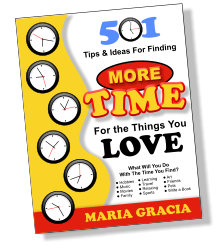
Find more time with the following tips from Maria Gracia’s book, titled (ad) 501 Tips and Ideas for Finding More Time for the Things You Love
Looking for practical ideas you can use straight away? Explore my own Forward Steps collection of 501 original tips and ideas for finding more time, covering everyday routines, home life, work, parenting, study and much more.
What would you do with an extra day in your week, extra weeks in your year? I know how I would use that time, doing the things I love doing!
 If you save 10 minutes here, 20 minutes there and 30 minutes someplace else, you’ve found an entire extra hour to spend however you wish.
Those extra minutes and hours add up quickly when you know the right time-saving tips and tools. Before you know it, those extra hours will easily add up to days and even weeks of extra time in your life.
Just think what that would do for the quality of your life!
I’d be doing you a disservice if I didn’t bring this amazing resource to your attention.
Get your copy of the (ad) 501 Tips and Ideas for Finding More Time for the Things You Love to ensure that you find all those extra minutes, hours, days and weeks you need to do everything you’ve always wanted to do.
It’s written by my friend, Maria Gracia, who just happens to be an organizing expert.
What would you do with an extra day in your week, extra weeks in your year? Share on XHere’s just a bit of an idea of Maria’s tips in her book:
 This tip will stop other people from stealing your time (No. 5)
How to get more done by doing less (No. 10)
This little tip will give you hours of extra time (No. 15)
Make reading time more efficient (No. 23)
The secret to making the toughest chores a breeze (No. 32)
A power tip for keeping your papers organized (No. 45)
Clutter is a time killer too, but not any more with these simple tips (No. 50-53)
This one time-saver could save you up to an hour a day (No. 58)
Discover the biggest time saving system ever (No. 68)
 A quick and easy grooming tip that can save you hours (No. 69)
Meal planning tips that save you time (No. 71, 72, 91, 93)
The free tool that performs like your personal secretary (No. 86)
You can significantly reduce your ironing time with this great tip (No. 94)
Watch your favorite TV shows in 25% less time (No. 100)
The best gardeners use this gardening time-saver (No. 125)
Since discovering this fantastic holiday gift buying tool our family and friends have saved a ton of time and frustration (No. 130)
Here’s a simple calendar tip that will save you a lot of time (No. 136)
The incredible free tool that helps you remember everything (No. 137)
Travel tips that save a ton of time (No. 140, 141, 242, 269 and more)
Powerful time-saving reading tips (No. 142)
End this shopping frustration and time waster (No. 143)
Save time and help your child learn more with this tip (No. 153)
Stop doing this one thing and you will save an extra 20-30 minutes a day (No. 158)
The greatest movie invention since ‘sound and color’ also saves you time (No. 167)
Here’s a quick and easy speed tip you’ll use every time you sit down at your computer (No. 177)
Use this simple trick and you’ll save yourself and others tons of time (No. 179)
 Here’s a powerful email speed tip that will save you time on every email you send (No. 180)
Get it done without doing it. Here’s the secret (No. 181)
Cut hours off of shopping with this easy tip (No. 186)
Laundry tips that cut the work (No. 205)
The greatest time-saving tip ever (No. 209)
The one time-saving tool no home should be without (No. 215)
The truth about multi-tasking (No. 221, 222)
Your favorite tunes can save you time with this fun tip (No. 251)
Cell phone tips that save you time (No. 256)
How to eliminate one of the biggest time wasters; ‘reinventing the wheel’ (No. 273)
Getting through airport security checkpoints fast and easy (No. 285)
Easy tips that cut down on kitchen time (No. 313, 317, 318 and more)
Get important things done with the “Big Rocks” concept (No. 343)
How to save ‘big’ time; this tip will do it (No. 353)
This little magic tool makes cleaning a breeze (No. 380)
Time saving tips at the grocery store (No. 408, 409)
Get your kids to stop what they’re doing and leave on time with the 10-5-1 system (No. 436)
Want to teach your child to ride a bike in record time? This amazing tool will do it (No. 456)
The best tip of all to give you time for the things you love (No. 488)
(ad) 501 Tips and Ideas for Finding More Time for the Things You Love is jam-packed with tips and ideas to help you make the very most out of every moment you’ve been given.
When you claim your copy of Maria Gracia’s resource, you will also get a bunch of complimentary bonuses.
501 original tips and ideas from Thea at Forward Steps
Finding more time does not always mean doing everything faster. Sometimes it means finding a simpler way to handle an everyday task, preventing a problem before it grows, removing an unnecessary step, making a decision once instead of repeatedly, sharing a task, changing a small habit that creates work every day or deciding that something no longer needs to be done. Explore these ideas and choose the ones that fit your circumstances, responsibilities and priorities.
I’ve put together this collection of my own 501 practical tips and ideas for finding more time in everyday life. Whether you’re renting or owning a home, working, running a business, raising a family, studying or simply trying to make more room for the things you enjoy, you’ll find ideas to explore and adapt to your circumstances.
Browse the sections, choose a few that suit your life and see which ones make a worthwhile difference.
Explore the 501 tips by topic
Choose a topic to jump straight to the ideas most relevant to you.
- Make everyday tasks take less time
- Plan your time around real life
- Reduce the time lost to digital distractions
- Make email and messages less time-consuming
- Make household cleaning more efficient
- Cook, eat and manage food with less effort
- Shop, pay bills and manage money efficiently
- Save time when renting a home
- Save time maintaining a home you own
- Make workdays more manageable
- Help business owners reclaim time
- Make study and learning more efficient
- Reduce the pressure of parenting
- Help teenagers manage their own time
- Share household responsibilities fairly
- Make appointments, calls and errands easier
- Make travel and getting around less stressful
- Manage health, wellbeing and personal care
- Protect relationships and make room for enjoyment
- Prevent small problems from becoming major time drains
- Create more time by changing how you approach life
1. Make everyday tasks take less time
- Keep a small basket near the entrance for items that need to leave the house, such as library books, returns and borrowed belongings.
- Put frequently used items where you naturally reach for them rather than where they look best on a shelf.
- Store the accessories needed for a task together, such as batteries beside the device that uses them.
- Keep a spare pen, notepad and charging cable in the places where you regularly need them.
- Choose a permanent home for keys, sunglasses and other items you often misplace.
- Use a small tray to collect the contents of your pockets when you arrive home.
- Keep scissors, tape and wrapping supplies together so gift preparation does not become a search.
- Place a reusable shopping bag beside the door after adding it to your next-trip list.
- Keep a basic household repair kit together rather than scattering its contents among drawers.
- Put frequently used cleaning supplies in an accessible, safe location on each relevant level of your home.
- Use a labelled container for items that need batteries, cables or replacement parts.
- Keep a written note of where seasonal belongings are stored before putting them away.
- Choose clothes with compatible colours and styles to reduce time spent deciding what matches.
- Set up a simple place to hang clothes that have been worn but do not yet need washing.
- Keep a spare set of commonly needed stationery in your work or study area.
- Store everyday dishes and glasses where they can be reached without moving other items.
- Keep a small rubbish bag handy during projects that create packaging or offcuts.
- Use one designated place for paperwork that needs action rather than leaving it on multiple surfaces.
- Keep a short list of household items that are running low so you can add them to your next shop.
- Put items back in their proper place when you finish using them, provided doing so is practical at the time.
- Use a labelled container for reusable cables, adapters and small electronic accessories.
- Keep a simple instruction sheet for appliances whose settings you frequently forget.
- When a routine task has several steps, arrange the supplies in the order you will use them.
- Notice which small inconvenience happens repeatedly and change the setup that causes it.
2. Plan your time around real life
- Plan tomorrow’s first task before finishing work today, so you do not begin by deciding what to do.
- Write down appointments with their travel time included, not just the meeting time.
- Leave a small gap between demanding commitments to absorb overruns and unexpected requests.
- Give each task a realistic time estimate based on how long it actually takes you.
- Compare your estimates with the time spent and adjust future plans accordingly.
- Choose three meaningful priorities for the day instead of creating an enormous task list.
- Mark tasks that must happen today separately from those that would merely be nice to finish.
- Schedule short preparation tasks before the event or deadline they support.
- Keep a running list of tasks that can be completed in ten minutes or less.
- Use waiting periods for suitable small tasks, but keep some waiting time free for rest.
- Review the coming week before agreeing to additional commitments.
- Put recurring responsibilities into a calendar instead of relying on memory.
- Record deadlines as well as the earlier date by which you want to have the work ready.
- Break a large task into a first action that can be completed without further planning.
- Set a stopping time for tasks that could otherwise expand indefinitely.
- Choose a realistic end point for the day rather than continually moving unfinished work forward.
- Plan a lighter period after a demanding event when your circumstances allow it.
- Keep one flexible block in your weekly schedule for unexpected errands and problems.
- Check tomorrow’s weather when it could affect clothing, travel or outdoor responsibilities.
- Plan around your own energy patterns when you have some control over the timing of tasks.
- Put the most important materials for tomorrow in one place before going to bed.
- Use a weekly review to remove obsolete tasks rather than carrying them forward indefinitely.
- Estimate how much time a new commitment will require each week before accepting it.
- When plans change, deliberately choose what will be postponed instead of trying to fit everything in.
3. Reduce the time lost to digital distractions
- Remove distracting apps from your phone’s home screen while keeping essential tools easy to reach.
- Turn off nonessential notifications that interrupt you without requiring immediate action.
- Use a focus setting during work, study or family time, allowing only important contacts through.
- Keep your phone outside arm’s reach during tasks that need concentration.
- Choose specific times to check social media instead of opening it whenever you have a spare moment.
- Unfollow accounts that repeatedly draw you into content you do not find worthwhile.
- Save useful online resources in a clearly labelled collection rather than keeping dozens of open tabs.
- Close browser tabs when you have finished with them and record any information you still need.
- Use a password manager to reduce time spent searching for login details and resetting passwords.
- Enable automatic software updates where appropriate, and schedule restarts at convenient times.
- Keep a secure digital copy of important documents so you can retrieve them without searching through paper files.
- Use your browser’s bookmarks for frequently visited work, school and service websites.
- Remove duplicate files and give important documents names that make them easy to find.
- Set a regular time to review photos and screenshots instead of letting them become an unmanageable collection.
- Keep your phone’s most-used settings accessible so common adjustments take fewer steps.
- Use a trusted calendar app that synchronises across your devices to avoid maintaining separate schedules.
- Store digital receipts in a designated folder or app when you may need them for returns or records.
- Use a timer for online research when you are prone to following unrelated links.
- Decide what question you want answered before searching the internet.
- Check whether an online article contains the information you need before reading every section.
- Use website search tools or page search to locate specific information in long documents.
- Keep a note of useful search terms for recurring research tasks.
- Set limits for games or entertainment apps when they regularly displace something more important to you.
- Review your digital subscriptions periodically and cancel services you no longer use.
4. Make email and messages less time-consuming
- Check email at planned intervals when your role does not require continuous monitoring.
- Use a small number of folders or labels that reflect how you actually retrieve messages.
- Create templates for routine replies such as appointment confirmations and requests for information.
- Use a clear subject line that helps the recipient understand the message before opening it.
- Put the action you need from the recipient near the beginning of the email.
- Ask one complete set of related questions rather than sending several messages in succession.
- Include relevant dates, reference numbers and attachments in the first message.
- Use email rules to sort predictable notifications away from messages requiring your attention.
- Archive messages that no longer need action instead of repeatedly rereading them in your inbox.
- Unsubscribe from mailing lists that rarely provide useful information.
- Use a short acknowledgement when a detailed response will take longer and the sender needs confirmation.
- Agree with colleagues or family members which communication channel is appropriate for urgent matters.
- Move complicated discussions to a call or meeting when repeated messages are creating confusion.
- Keep a reusable checklist for sending documents that must include several attachments.
- Review the recipient list before sending sensitive or consequential messages.
- Use calendar invitations for agreed meetings instead of exchanging multiple scheduling emails.
- Include your availability when asking someone to arrange a meeting.
- Use a shared document for ongoing information that several people would otherwise request repeatedly.
- Set a reminder to follow up on important messages rather than checking for replies constantly.
- Keep a record of decisions made by email when you may need to refer to them later.
- Write a draft first when a message is emotionally charged, then review it before sending.
- Use concise paragraphs and lists when the recipient needs to respond to several distinct points.
- Agree on a reasonable response time with people who routinely message you outside working hours.
- Turn off read receipts or message previews if they create pressure to respond immediately and you do not need them.
5. Make household cleaning more efficient
- Clean small spills when they occur so they do not become larger jobs later.
- Keep a washable cloth near common spill areas, stored safely and away from food contamination.
- Use a laundry basket in the room where clothes are usually removed rather than expecting everyone to carry them elsewhere.
- Teach household members which items can go directly into the dishwasher or laundry basket.
- Check clothing care labels before washing unfamiliar garments to avoid preventable damage and rework.
- Sort laundry according to the care requirements that matter in your household, not by an unnecessarily complicated system.
- Wash a full, appropriate load when practical instead of repeatedly running small loads.
- Set a reminder to move laundry when leaving it in the machine would cause extra work.
- Keep stain-treatment supplies together and check garment instructions before treating a stain.
- Fold or hang clothes while they are still easy to manage, rather than allowing a large clean pile to accumulate.
- Assign each household member responsibility for putting away their own clean clothes when appropriate.
- Use a small cleaning caddy for the supplies needed in one area, rather than carrying unrelated products around.
- Choose cleaning tools that suit the surfaces in your home to reduce repeated effort or damage.
- Keep frequently used bathroom supplies accessible so a quick wipe-down is easy to begin.
- Use a squeegee on suitable shower surfaces after use to reduce later cleaning effort.
- Follow product directions and never mix cleaning chemicals, particularly bleach with other cleaners.
- Clean high-touch areas as part of an existing routine rather than waiting for a major cleaning session.
- Use washable covers or mats in areas that receive frequent dirt, where suitable.
- Keep a small rubbish container near a craft or hobby area to collect scraps as you work.
- Put cleaning tools away immediately after use so they are ready for the next task.
- Clean one shelf or drawer while waiting for another suitable household task to finish.
- Keep a note of maintenance tasks that are easy to forget, such as cleaning appliance filters according to the manual.
- Ask household members to leave shared spaces ready for the next person to use.
- Choose a practical standard of cleanliness that suits your household rather than repeatedly cleaning areas that do not need it.
6. Cook, eat and manage food with less effort
- Choose several meals for the week before shopping, taking account of existing food and upcoming commitments.
- Keep a short list of dependable meals that use ingredients you commonly have on hand.
- Plan one flexible meal each week that can use leftover vegetables or other suitable ingredients.
- Check the fridge and pantry before making a shopping list to avoid buying duplicates.
- Keep a visible list of food nearing its use-by date and plan how to use it safely.
- Prepare ingredients for the next meal while already working in the kitchen, when it is convenient.
- Wash and cut produce in batches when doing so will not compromise its freshness or safe storage.
- Use the same ingredient in more than one planned meal to reduce waste and preparation time.
- Label leftovers with their contents and date so they can be identified and used safely.
- Freeze suitable portions of meals for days when cooking from scratch is unrealistic.
- Keep a list of meals that freeze and reheat well for your household.
- Choose recipes that match the time and equipment actually available on the day.
- Read the full recipe before starting so you can identify long waits and missing ingredients.
- Measure ingredients before beginning a recipe with several stages.
- Use a kitchen timer for unattended cooking steps instead of relying on memory.
- Clean utensils as you go when it is safe and does not distract from cooking.
- Keep commonly used spices and cooking tools near the preparation area, away from heat and moisture where needed.
- Prepare lunch portions while packing away dinner if the food is suitable for safe storage.
- Keep quick, balanced meal options available for days when plans change.
- Use frozen vegetables or other convenient ingredients when they suit the recipe and reduce preparation.
- Set up a breakfast station with the items used each morning, while storing food safely.
- Give family members age-appropriate responsibility for preparing parts of a meal.
- Keep a list of reliable takeaway or ready-meal options for genuinely overloaded days.
- Plan how to use leftovers before ordering additional food.
7. Shop, pay bills and manage money efficiently
- Keep a running shopping list where household members can add items as they notice they are running low.
- Group shopping-list items by the layout of your usual supermarket to reduce backtracking.
- Check store opening hours and stock information before making a special trip.
- Keep receipts for purchases that may need returning, and note the return deadline when relevant.
- Store warranties and proof of purchase with the corresponding product information.
- Maintain a list of regular bills with due dates and payment methods.
- Use direct debit for suitable predictable bills only when your account balance and payment arrangements make it safe.
- Set calendar reminders for bills that you prefer to review before paying.
- Review automatic payments periodically to identify subscriptions or services you no longer need.
- Keep important financial documents in a secure, consistently organised location.
- Use a household budget that reflects actual spending rather than relying on rough assumptions.
- Compare the total cost of a purchase, including delivery, fees and ongoing expenses.
- Keep a list of questions to ask before buying an expensive item so you do not need several follow-up enquiries.
- Check measurements and compatibility before ordering household items or replacement parts.
- Combine errands in the same area when the opening hours and travel arrangements make this practical.
- Keep reusable bags and any necessary shopping aids in the car or near the exit, as appropriate.
- Use a standard list for recurring purchases such as school supplies, office materials or pet food.
- Photograph a product label or model number before shopping for a replacement.
- Set a reminder to review insurance renewal notices before the deadline.
- Keep a list of service providers and account reference numbers in a secure place.
- Compare quotes using the same specifications so that you do not waste time comparing unlike services.
- Prepare documents before contacting a bank, insurer or utility provider.
- Ask providers whether they offer online forms or scheduled callbacks for routine enquiries.
- Keep a brief record of customer-service conversations, including dates, names and agreed next steps.
8. Save time when renting a home
- Keep your lease, condition report, inspection correspondence and important rental documents together.
- Photograph the condition of the property when moving in and store the images with clear dates and room labels.
- Keep a list of maintenance issues, including when each problem was first noticed and reported.
- Report repairs in writing through the required channel so there is a clear record.
- Include the room, location, description and available photographs when reporting a maintenance problem.
- Keep copies of emails and messages about inspections, access arrangements and repairs.
- Place inspection dates in your calendar as soon as they are confirmed.
- Use a repeatable inspection checklist for tasks you want to complete before an inspection.
- Keep a small container for items that need to be moved out of sight temporarily during an inspection.
- Ask the property manager for clarification in writing when an instruction or deadline is unclear.
- Check your lease and local tenancy rules before making changes to fixtures or fittings.
- Keep a list of questions for your property manager and send related questions together.
- Store appliance manuals and warranty information for items you own, separate from property-owned equipment.
- Check which maintenance responsibilities belong to the renter and which belong to the rental provider under local rules.
- Keep a record of meter readings when required or useful for a move.
- Photograph the condition of the property when moving out and retain copies of relevant correspondence.
- Start arranging utility transfers and address changes early enough to avoid last-minute calls.
- Measure furniture and doorways before arranging a delivery to a rental property.
- Keep a list of approved changes or permissions in writing where your tenancy requires consent.
- Record the dates and details of keys, remotes and access devices supplied or returned.
- Keep an emergency contact list for urgent property issues, following the process set out by your rental provider.
- Before booking a tradesperson yourself, check the applicable approval and payment arrangements for your tenancy.
- Keep a folder of evidence if a repair remains unresolved, including dates, photos and responses.
- When considering a move, compare the full costs and time involved in each option before committing.
9. Save time maintaining a home you own
- Keep a home maintenance calendar based on manufacturer guidance, local conditions and the age of your property.
- Record appliance model numbers and purchase dates before you need a repair or replacement.
- Store manuals digitally in a folder named for the appliance or system.
- Keep contact details for trusted tradespeople and note the work they have completed.
- Photograph the location of hidden shut-off valves, electrical boards and other important home systems.
- Learn where the main water shut-off is and make sure relevant household members know too.
- Keep a list of recurring maintenance issues that should be mentioned when obtaining a professional inspection.
- Inspect accessible areas for leaks or damage periodically, without entering unsafe spaces.
- Clean appliance filters according to the manufacturer’s instructions to maintain suitable performance.
- Replace smoke-alarm batteries or service alarms according to the applicable requirements and instructions.
- Keep paint colours, finish details and leftover product information for future touch-ups.
- Label spare keys clearly without attaching your home address to them.
- Maintain a list of exterior maintenance tasks that depend on the season or weather.
- Check gutters, roofs and elevated areas safely, using a qualified professional when access is hazardous.
- Keep receipts and records for major repairs, renovations and improvements.
- Photograph existing damage before a repair or renovation begins.
- Measure spaces before buying replacement furniture, appliances or storage units.
- Group planned repairs by trade or area when this reduces visits and disruption.
- Ask contractors to specify the work, exclusions, expected timing and access requirements in writing.
- Prepare the work area before a booked repair visit, while leaving technical work to qualified people.
- Keep a short list of unfinished home projects and identify the next action for each one.
- Finish or remove abandoned projects that continue to occupy space and require repeated decisions.
- Check the maintenance requirements of a new appliance before purchase, not only its price and features.
- Set aside a small regular period to review upcoming home maintenance rather than waiting for urgent failures.
10. Make workdays more manageable
- Write down the outcome expected from a task before beginning work on it.
- Clarify the deadline and priority when a request arrives without either.
- Ask which existing task should be delayed when someone adds an urgent responsibility to a full workload.
- Keep a running note of interruptions that require follow-up so you can return to your main task.
- Prepare the documents and applications needed for a meeting before it begins.
- Send an agenda for meetings that require decisions or preparation.
- End meetings by recording decisions, owners and due dates.
- Decline or shorten meetings when your attendance is not necessary and workplace rules allow it.
- Use a shared task board when several people need visibility into the status of the same work.
- Agree on a clear definition of “finished” before a task is handed over.
- Batch similar administrative tasks to reduce the mental cost of switching between different activities.
- Keep a reusable checklist for work you perform repeatedly.
- Save a clean template for reports, proposals or documents that follow a consistent structure.
- Record common troubleshooting steps when resolving a technical problem that may recur.
- Keep reference material close to the task where it is used.
- Use keyboard shortcuts for actions you perform frequently, learning a few at a time.
- Take brief notes when interrupted so you can resume work without reconstructing your thoughts.
- Agree with colleagues on what genuinely requires an immediate response.
- Reserve focused work periods for tasks that are difficult to complete amid constant interruptions.
- Check the accuracy of a document before sending it to reduce avoidable correction cycles.
- Ask for examples when a request is vague instead of producing work that may need to be redone.
- Keep a handover note for work that continues across shifts, days or staff changes.
- Review recurring tasks for unnecessary approvals, duplicate data entry or repeated reporting.
- At the end of the day, record the next action for unfinished work so restarting is easier.
11. Help business owners reclaim time
- Write down the steps involved in a recurring business task before deciding what to automate.
- Create a standard onboarding checklist for each type of new client or customer.
- Prepare reusable responses for frequently asked questions, then personalise them where necessary.
- Keep current service descriptions, prices and terms in one authoritative location.
- Use an intake form to collect the information needed before a consultation or job begins.
- Ask clients to provide required files in a consistent format to reduce conversion and clarification work.
- Set clear office hours and response expectations so customers know when to expect a reply.
- Use appointment scheduling tools when they genuinely reduce back-and-forth messages.
- Send appointment reminders with the time, location, preparation instructions and cancellation process.
- Keep a checklist for opening and closing the business or worksite.
- Review recurring software subscriptions and remove tools that duplicate existing functions.
- Document important business processes so routine work does not depend on one person’s memory.
- Give staff authority to resolve defined low-risk issues without seeking approval each time.
- Agree on spending or decision limits that allow staff to act within clear boundaries.
- Use a consistent naming system for client files so records can be found quickly.
- Keep customer notes factual, relevant and stored securely in the appropriate system.
- Set up a clear process for handling complaints so each one has an owner and next step.
- Use a simple dashboard to track the few business measures that inform decisions.
- Batch invoicing and routine bookkeeping when deadlines and cash-flow needs permit.
- Reconcile transactions regularly rather than allowing discrepancies to accumulate.
- Keep supplier details, ordering terms and reorder points accessible to authorised staff.
- Review jobs that repeatedly exceed their estimated time and adjust pricing or processes accordingly.
- Schedule time for business planning rather than allowing every day to be consumed by immediate demands.
- Identify tasks that could be delegated, outsourced or discontinued after considering cost, quality and risk.
12. Make study and learning more efficient
- Before a study session, identify the question or skill you want to understand by the end.
- Keep assignment instructions and marking criteria beside your working notes.
- Break a major assignment into research, planning, drafting, checking and submission stages.
- Record each assignment deadline in a calendar along with an earlier personal deadline.
- Use one consistent file-naming pattern for course, subject and assignment documents.
- Keep class notes in a format that makes key ideas and unanswered questions easy to locate.
- Write down questions during study so you can seek clarification in one batch.
- Use short self-tests to discover which material you can recall without looking at your notes.
- Review difficult concepts again after a gap instead of repeatedly rereading them in one sitting.
- Keep a list of errors you make repeatedly and review it before similar assessments.
- Start research with the assignment question so you do not collect unrelated information.
- Record source details while researching instead of trying to reconstruct them later.
- Separate quotations, paraphrases and your own thoughts clearly in research notes.
- Check citation requirements before writing the final draft.
- Ask a teacher or tutor a specific question and include what you have already tried.
- Use a dedicated study space or portable study kit so setup takes less time.
- Download or gather permitted learning materials before studying somewhere with unreliable internet.
- Keep a list of useful reference websites and databases for each subject.
- Use a timer to structure practice sessions, with breaks suited to the task and your concentration.
- Complete a rough outline before polishing sentences or formatting.
- Leave time to check file formats, attachments and submission confirmations.
- Keep a backup of important work in a secure location separate from the original device.
- Explain a difficult concept aloud in your own words to reveal gaps in understanding.
- After each class or training session, record the next action needed to keep your learning moving.
13. Reduce the pressure of parenting
- Keep a shared family calendar that shows appointments, school events and care arrangements.
- Agree on who is responsible for each regular child-related task rather than assuming someone will notice.
- Pack school bags the night before when this suits your family’s routine.
- Keep a checklist near the door for items children frequently forget.
- Store spare school supplies together so last-minute requests are easier to handle.
- Put permission slips and forms in one visible action folder as soon as they arrive.
- Set reminders for school payment dates, excursions and uniform requirements.
- Keep a list of each child’s current clothing and shoe sizes for shopping.
- Label children’s belongings according to school or care requirements.
- Prepare a small outing kit with age-appropriate essentials and replenish it after use.
- Keep a list of meals children will reliably eat when planning busy evenings.
- Teach children to put their own belongings in an agreed place as soon as they arrive home.
- Give children age-appropriate choices about when to complete routine responsibilities.
- Use a visible routine chart for repeated morning or bedtime steps when it helps your child.
- Prepare for predictable transitions, such as leaving the playground, with an agreed warning and plan.
- Keep emergency contact and care information current and accessible to authorised caregivers.
- Share relevant care instructions with babysitters or family helpers in a concise written format.
- Coordinate appointments for siblings on the same day when practical and not overly tiring.
- Ask schools or activity providers about schedules and requirements early in the term.
- Keep a list of children’s recurring activities and the equipment each one requires.
- Rotate toys or activity supplies so fewer choices need to be managed at once.
- Keep a container for outgrown clothes and review it periodically before donating or passing items on.
- Build a realistic buffer into travel time with children rather than planning to arrive at the last possible minute.
- Arrange specific, manageable jobs for children when preparing for family events.
14. Help teenagers manage their own time
- Use a calendar that shows school deadlines, work shifts, activities and social commitments together.
- Set reminders for starting assignments, not just for their final due dates.
- Keep school, sport and work equipment in separate labelled sections of a bag when practical.
- Prepare the next day’s clothes and essentials before settling in for the night.
- Keep a list of recurring school tasks that tend to be forgotten, such as charging a device.
- Break large projects into small actions that can be completed between other commitments.
- Estimate how long homework actually takes and use the information to plan future evenings.
- Keep a list of questions to ask teachers rather than waiting until an assignment is nearly due.
- Check transport options and departure times before committing to an activity.
- Set a regular time to review upcoming assessments and shifts.
- Use a simple weekly spending plan to avoid last-minute financial scrambles.
- Keep essential identification, travel cards and other important items in a consistent place.
- Use focus settings during homework and allow essential family or emergency contacts through.
- Agree with friends on plans early enough to organise transport and other responsibilities.
- Keep a backup copy of assignments and creative work.
- Save teacher instructions and feedback in a place that can be found before the next assessment.
- Ask for help when instructions are unclear instead of spending hours guessing what is required.
- Set a personal deadline earlier than the official deadline for tasks that need checking.
- Prepare work or sports clothes in advance when the next day begins early.
- Learn a few basic meals that can be prepared safely without needing an adult to organise every step.
- Keep a checklist for leaving home that reflects the day’s actual plans.
- Use spare periods between school and activities for suitable homework or preparation tasks.
- Review commitments before taking on a new club, job or activity.
- Keep one realistic block of free time rather than filling every available hour with obligations.
15. Share household responsibilities fairly
- Write down recurring household jobs so invisible tasks become easier to discuss and divide.
- Assign responsibility for a task from beginning to end, including noticing when it needs doing.
- Rotate less popular chores using an agreed schedule rather than renegotiating them every time.
- Match household jobs to people’s availability and abilities instead of assuming everyone has the same capacity.
- Teach each person how to complete a shared task to an agreed standard.
- Keep household instructions in a shared place so one person is not always asked how things work.
- Use a common shopping list that all relevant household members can update.
- Agree on a method for communicating urgent household needs without sending messages to multiple people.
- Schedule a brief household check-in to resolve small problems before they become recurring arguments.
- Keep a list of shared supplies that need replenishing and decide who checks them.
- Use a family or housemate calendar for shared appointments and planned absences.
- Agree on how clean shared spaces should be left for the next person.
- Set up a clear process for handling deliveries, parcels and items collected for other household members.
- Keep frequently used shared tools in a known location and return them after use.
- Make a simple checklist for tasks required before leaving a shared home for a trip.
- Discuss which jobs can be simplified rather than automatically dividing every existing task.
- Use a shared note for household decisions that everyone needs to remember.
- Agree on a backup plan when the person responsible for a task is unavailable.
- Give children or teenagers responsibility for complete, manageable tasks rather than only isolated steps.
- Plan shared cooking or cleaning sessions when working together genuinely saves time.
- Review household arrangements after a change in work hours, study, health or caring responsibilities.
- Use a neutral reminder system for agreed chores so one person does not have to keep prompting everyone.
- Keep a list of tasks that can be dropped or done less often when the household is under pressure.
- Recognise and adjust unequal workloads before exhaustion or resentment becomes the main driver of change.
16. Make appointments, calls and errands easier
- Before calling a service provider, gather your account details and the documents likely to be requested.
- Write down the outcome you want from a phone call before dialling.
- Prepare the questions you need answered and tick them off during the conversation.
- Ask whether a callback is available when waiting on hold would disrupt other responsibilities.
- Keep a brief note of the date, outcome and promised next step after important calls.
- Ask for written confirmation of important changes agreed over the phone.
- Check whether a form or online portal can handle a routine request before making a call.
- Confirm appointment locations, parking or arrival instructions before leaving home.
- Keep a list of documents required for recurring appointments so preparation becomes easier.
- Book appointments with travel time and likely waiting time in mind.
- Ask about cancellation lists if an earlier appointment would genuinely help you.
- Keep a reminder of follow-up appointments or tests that a provider has asked you to arrange.
- Put all errands requiring a specific opening time into your calendar.
- Check whether an item can be returned by post or at a closer location before making a special trip.
- Keep parcels and returns together with their labels or instructions until they are sent.
- Use a checklist for errands involving several stops so nothing is missed.
- Confirm that a service provider covers your location before arranging a quote or visit.
- Ask what information a tradesperson needs before a site visit to avoid repeat appointments.
- Keep relevant reference numbers beside the appointment or enquiry in your calendar.
- Choose quieter appointment times when you have flexibility and reliable information about demand.
- Use online check-in or pre-appointment forms when they are available and appropriate.
- Keep a record of questions that arise after an appointment so they can be raised together.
- Arrange repeat appointments before leaving when the provider recommends this and the schedule is known.
- Review whether a recurring errand can be handled remotely, combined with another trip or delegated safely.
17. Make travel and getting around less stressful
- Check your route before leaving when unfamiliar roads, roadworks or public transport changes may affect the journey.
- Allow extra time for journeys with fixed arrival deadlines.
- Keep a small travel checklist for items you often forget when leaving home.
- Check public transport timetables before setting out, especially on weekends or public holidays.
- Save ticketing and transport apps on your phone’s home screen when you use them regularly.
- Keep a secure backup payment method available for travel disruptions.
- Refill a reusable water bottle before a long trip when safe drinking water is available.
- Pack frequently needed travel items in a consistent section of your bag.
- Keep a note of parking location and level when using a large car park.
- Take a photo of your parking sign or ticket details when this helps you remember restrictions.
- Check luggage allowances before packing for a flight or organised trip.
- Keep travel documents together in a secure, accessible location.
- Download tickets, directions or essential information before entering an area with unreliable reception.
- Agree on a meeting point and backup plan when travelling with a group.
- Keep a small supply of permitted travel essentials in your usual bag and replenish it after use.
- Check the fuel or charging needs of your vehicle before a long journey.
- Plan rest stops on longer drives rather than relying on reaching the destination without a break.
- Use navigation instructions that you can follow safely without handling your phone while driving.
- Check whether a delivery or pickup can be scheduled to coincide with an existing trip.
- Keep a list of regular destinations with their access or parking details.
- Choose a practical meeting location that reduces total travel for everyone when possible.
- Check weather conditions before outdoor travel and allow time for suitable clothing or equipment.
- Keep an alternative route or transport option in mind for journeys where disruption would cause serious problems.
- After a trip, return travel documents and reusable items to their designated places so they are ready next time.
18. Manage health, wellbeing and personal care
- Keep a current list of medications and relevant instructions for use, stored securely.
- Use reminders for routine health tasks when you might otherwise forget them.
- Arrange repeat prescriptions or supplies before you are close to running out, following your provider’s advice.
- Keep appointment details and follow-up instructions together after a medical visit.
- Write down symptoms or questions before an appointment so important points are not forgotten.
- Keep emergency contact details accessible to the people who may need them.
- Store first-aid supplies together and check their contents and expiry dates periodically.
- Keep frequently used personal-care products in one organised location.
- Replace depleted toiletries when you notice they are running low rather than waiting until the next use.
- Prepare work or exercise clothing in advance when it helps you follow through on your plans.
- Choose a form of movement that fits your schedule and can be done without elaborate preparation.
- Keep suitable snacks available for days when meetings or travel disrupt normal meal times.
- Use recurring calendar reminders for preventive appointments recommended by your health professional.
- Keep a list of questions about a new treatment or health instruction to clarify with a qualified professional.
- Make essential rest time visible in your schedule instead of treating it as optional leftover time.
- Notice which commitments consistently leave you depleted and consider whether they can be adjusted.
- Keep a simple evening routine that makes the next morning less rushed.
- Prepare comfortable clothing and necessary equipment before a planned outdoor activity.
- Use a written checklist when managing a complicated care routine for yourself or someone else.
- Ask a healthcare provider whether a follow-up can be completed remotely when appropriate and available.
- Keep health records and test results in the secure system recommended by your provider.
- Choose realistic goals for changes to sleep, movement or meal routines rather than attempting several major changes at once.
- Build recovery time into plans after unusually demanding work, travel or caring periods.
- Seek appropriate professional advice when a health concern needs more than a time-management solution.
19. Protect relationships and make room for enjoyment
- Arrange social plans with a clear date and time rather than leaving every detail open indefinitely.
- Suggest two practical meeting options when coordinating with someone whose schedule is busy.
- Use a shared calendar for family occasions that require preparation or travel.
- Keep a list of thoughtful gift ideas when someone mentions something they would enjoy.
- Set reminders for important occasions that matter to you, rather than relying on last-minute memory.
- Keep a small collection of greeting cards or digital message drafts for occasions you regularly acknowledge.
- Ask guests about practical needs in advance when hosting a meal or gathering.
- Choose a gathering format that suits the time and energy available, rather than automatically planning a large event.
- Share preparation and cleanup tasks with willing guests or household members when appropriate.
- Keep a list of low-effort activities you enjoy for days when you need a break but lack inspiration.
- Plan simple outings that do not require extensive booking, travel or preparation.
- Combine a catch-up with a walk or another activity you already planned when both people enjoy that format.
- Agree on a finish time for social plans when you have another commitment or need to protect rest.
- Respond to invitations within a reasonable period so arrangements do not remain unresolved.
- Be clear when declining a request rather than leaving the other person uncertain.
- Schedule time with people who matter to you instead of assuming it will happen when everything else is finished.
- Keep a shared list of activities family members would like to do together.
- Use a recurring reminder to contact distant friends or relatives if maintaining contact matters to you.
- Choose meaningful rituals that are simple enough to maintain during busy periods.
- Keep a list of local activities or places you would like to explore when you have an unexpected free afternoon.
- Limit event planning to the details that materially affect the experience rather than perfecting every small choice.
- Ask others what kind of help would be useful before spending time on a gesture they may not need.
- Protect some unplanned time for curiosity, creativity or simply doing nothing.
- Review whether an obligation is strengthening a relationship or merely filling time through habit.
20. Prevent small problems from becoming major time drains
- Deal with a small administrative problem while the relevant details are still easy to remember.
- Keep a list of recurring minor frustrations and choose one to fix each week.
- Replace worn-out everyday items before their failure repeatedly interrupts essential tasks.
- Keep spare batteries or suitable charging equipment for essential devices, stored safely.
- Back up important files on a schedule appropriate to how often they change.
- Test backup access occasionally so you know the files can actually be restored.
- Keep account recovery details current and stored securely.
- Check that important contact information remains up to date after a move or change of provider.
- Read instructions before assembling unfamiliar products to avoid having to undo incorrect steps.
- Check measurements and specifications before starting a DIY project or ordering materials.
- Keep a record of the materials used in a repair so future matching or replacement is easier.
- Photograph the finished arrangement of complicated cables before disconnecting equipment.
- Label similar-looking containers or cables when confusing them would create repeated work.
- Keep a small stock of essential household consumables without accumulating excessive duplicates.
- Use reminders for perishable items or supplies that require periodic checking.
- Confirm important arrangements shortly before they are due when a misunderstanding would be costly.
- Ask for clarification as soon as a problem appears rather than waiting until a deadline is close.
- Keep a record of recurring technical errors and the solutions that worked.
- Update checklists when a process changes so outdated instructions do not cause repeated mistakes.
- Use a secure method to dispose of sensitive paperwork and digital information you no longer need.
- Review privacy settings and account permissions periodically to reduce future security complications.
- Keep an accessible list of emergency procedures for your home or workplace.
- Notice when repeatedly repairing a cheap or unsuitable item is costing more time than replacing it would.
- After resolving a recurring problem, change the process or setup that allowed it to keep happening.
21. Create more time by changing how you approach life
- Ask what would happen if you did not do a task at all before automatically adding it to your schedule.
- Distinguish between a responsibility that is genuinely yours and one you have gradually taken over.
- Set a personal limit on how many major projects you will actively pursue at once.
- Choose a good-enough standard for low-consequence tasks that do not warrant perfection.
- Ask whether a tradition can be simplified while preserving the part that matters most.
- Review recurring commitments at regular intervals rather than treating past agreement as permanent.
- Before volunteering, check the actual time required, including preparation, travel and follow-up.
- Practise saying, “I need to check my commitments before I can answer,” instead of agreeing immediately.
- When accepting a new responsibility, agree on its boundaries and what success will look like.
- Keep a list of tasks you have deliberately decided not to do, so you do not repeatedly reconsider them.
- Notice when researching more options is delaying a decision that already has enough information.
- Set a decision deadline for reversible, low-risk choices that do not deserve endless comparison.
- Spend more preparation time on decisions that are expensive or difficult to reverse.
- Ask whether a recurring meeting, report or routine still serves its original purpose.
- Replace a complicated personal system with a simpler one if maintaining the system itself consumes time.
- Allow other people to complete shared tasks in their own reasonable way instead of redoing everything to match your preferences.
- Accept help with a specific task when it would make a meaningful difference and the person is willing.
- Offer help in a defined way, such as one errand or one afternoon, rather than making vague promises.
- Identify the time of day when you are most likely to overcommit and make decisions more cautiously then.
- Leave some room in your plans for delays, mistakes and ordinary human needs.
- Measure the value of an activity by what it contributes, not simply by how busy it makes you feel.
- Choose a small number of personal priorities to guide decisions about work, money and free time.
- Review how you spent your time without judging yourself, looking instead for one useful adjustment.
- Make a deliberate choice about what you want the time you save to be used for.
- Revisit your time-saving habits every few months and keep only those that genuinely improve your life.
How Can You Find More Time for What Matters?
Eight questions to help you discover your current approach to time. We all have the same number of hours in a day, but small changes in how we plan, organise, protect and use those hours can make a surprising difference. Choose the response that most closely reflects what you would actually do.
The Intentional Prioritiser
You want your time to count. You recognise that being busy is not necessarily the same as making progress, and you are drawn to activities that contribute to something meaningful. Your biggest opportunity may be deciding what deserves your attention before the day takes over.
Your next step is to choose three things that would make today feel worthwhile. Give the most important one some attention before less significant tasks fill the available space. You do not have to do everything; you can make a difference by doing what matters most.
For practical inspiration, explore the free 34 Time Abundance Tips ebook. It may help you discover new ways to reclaim time for your priorities.
When you are ready to reflect on another area of your life, try a different self-discovery activity from the Personal Growth Quizzes collection.
The Time Protector
You may be generous with your time, responsive to other people and willing to help when something needs doing. Those are valuable qualities, but when every request becomes your responsibility, your own needs and goals can end up at the bottom of the list.
Your next step is to practise a small, respectful boundary. Before agreeing to a request, pause and consider what it would displace. You can be helpful without always saying yes, and you can make room for rest, relationships and activities that matter to you.
Discover practical ideas for creating more breathing room with the free 34 Time Abundance Tips ebook. A few thoughtful changes may help you use your time in ways that feel better for you.
If you would enjoy another opportunity to reflect on your choices and habits, explore the Personal Growth Quizzes page and choose a topic that speaks to you.
The Practical Organiser
You appreciate having a plan, knowing where things belong and being able to approach tasks in an orderly way. Simple systems and routines can save repeated effort and make busy days feel more manageable. Your opportunity may be to create systems that genuinely help, without making organisation another job in itself.
Your next step is to choose one recurring source of wasted time. Perhaps it is searching for misplaced items, deciding what to do next or preparing at the last minute. Create one simple routine to address it, then notice whether it makes your week easier.
For more ideas to streamline everyday life, take a look at the free 34 Time Abundance Tips ebook. You may find a practical suggestion you can put to use straight away.
For more ideas to support your personal growth, visit the Personal Growth Quizzes page and discover another area to explore.
The Clever Simplifier
You are interested in finding easier ways to get things done. Rather than assuming every task must be completed in the usual way, you are open to shortcuts, simpler methods and questioning habits that consume time without adding much value.
Your next step is to look at one ordinary task you repeat regularly. Could you prepare for it in advance, reduce unnecessary steps, share the responsibility or decide that it no longer needs doing? Even a small saving, repeated over time, can add up to a useful amount of reclaimed time.
Keep your ideas flowing with the free 34 Time Abundance Tips ebook. It offers another place to look for ways to make more room for the things you love.
When you feel like another little challenge, explore the Personal Growth Quizzes collection for more opportunities to reflect and take a positive step forward.
Explore This Idea Further
Optional prompts to help you make the ideas your own.
I use AI as a thinking companion, not as a replacement for my own thinking. These prompts are simply another way to explore the ideas in this article and see how they might apply to your own life.
You don’t have to use AI to benefit from them. You can copy a prompt into a notebook, write about it in your journal, talk it through with someone you trust or simply sit with the question and see what comes up for you. If you do use ChatGPT or another AI tool, treat its responses as a starting point for your own thinking.
You remain the person who decides what is useful and right for your life.
How to use these prompts: Choose the one that appeals to you, copy the complete prompt and paste it into ChatGPT or another AI tool. You can answer its questions and continue the conversation as you go.
1. Apply This To My Life
Use this prompt when you want to discover which of the article’s time-saving ideas could make a genuine difference in your everyday life.
I want to find more time for the things that matter to me without making my days feel even more crowded. Use the Forward Steps article “Finding More Time With 501 Tips And Ideas” as your primary source and help me discover which of its ideas could make a genuine difference in my everyday life.
Ask me a few relevant questions about how I currently spend my time, what is taking up most of my attention and what I would like more time for. Then help me identify practical opportunities to save time, simplify tasks, reduce unnecessary demands or make better use of the time I already have, drawing on the article’s ideas wherever they fit my circumstances.
Keep your suggestions realistic for my responsibilities and daily routine. Help me focus on the ideas most likely to be useful to me rather than trying to apply too many at once. Build on my answers as we continue, keeping the article at the centre of our conversation.
2. Reflect More Deeply
Use this prompt when you want to examine your everyday habits and discover where you might be making tasks harder or more time-consuming than they need to be.
I wonder how much time I could reclaim by looking differently at the way I handle everyday tasks. Use the Forward Steps article “Finding More Time With 501 Tips And Ideas” as your primary source and help me explore my habits and assumptions about how I spend my time.
Guide me through a thoughtful conversation about which everyday activities consume more time than I realise, where I may be making tasks harder than they need to be and whether I am overlooking simpler ways of doing things. Help me consider the article’s examples of saving time through organisation, reducing clutter, making chores easier, planning meals, handling reading and emails more efficiently, and avoiding unnecessary repetition.
Ask me one or two useful questions at a time and build on my answers. Help me reflect on what I could change, what genuinely deserves my time and how finding small pockets of time might create more room for the things I enjoy. Keep our discussion grounded in the article’s practical approach rather than turning it into a general lesson about productivity.
3. Turn It Into Action
Use this prompt when you are ready to try a practical time-saving change and put the time you gain towards something you value.
Help me find some usable time in my week and put it towards something I genuinely want to do. Use the Forward Steps article “Finding More Time With 501 Tips And Ideas” as your primary source and help me turn one or two of its practical time-saving ideas into action.
First, ask me a few questions about the tasks or routines that take up much of my time, what I would love to have more time for and what my daily responsibilities allow. Then help me choose one area where a small change could make a worthwhile difference. Draw on the article’s ideas about simplifying chores, organising papers and belongings, planning meals, making reading or email more efficient, using helpful tools and avoiding unnecessary duplication.
Help me create a simple plan with one or two changes to try, how I could fit them into my existing routine and how I might tell whether they are saving time. Help me decide what to do with any time I gain, so it can go towards something I enjoy or value rather than automatically filling it with another task.
Keep the plan realistic and manageable. Don’t overwhelm me with a long list of tips or expect every idea to work perfectly. Build on my answers as we continue and help me focus on one useful change I can start making now.
Tip: You don’t have to use all three. Start with the one that feels most useful to you right now.

Hi, I'm Thea Westra at Forward Steps (forwardstepsblog.com)
CLICK HERE To Trigger More Of Those Forward Steps 'Aha' Light Bulb Moments!