

I was thinking about a piece of advice we see around the place so often. It reminds me of a book I recently read, (ad) Feelings Buried Alive Never Die.
The idea is that when we like or dislike something about another person, it can sometimes reflect an attribute we like or dislike about ourselves. In other words, another person may be mirroring something back to us.
I decided to run through this in my mind.
What Are Our Relationships Trying To Show Us?
Which people do I most admire? What is it about them that I like so much?
Then I thought about the people who annoy me. What is it about them that grates on me?
 I was curious to discover which aspects of myself might benefit from a little more “work”.
While thinking about the latter, I realised that some of those attributes are not part of my life today. Rather, they belong to my past.
A couple of the things I disliked about particular people are not things that describe me now, yet they do describe some of the ways I used to be.
I concluded (and this is important), that those elements from my past, were likely parts of me for which I’d not yet forgiven myself.
Which is precisely the reason that they are still “alive” today and are instantly activated when I meet someone who demonstrates those behaviors.
What Are We Still Carrying?
We all have a history.
There are things we have done that we are proud of, things we wish we had done differently and things we may prefer not to think about at all.
Sometimes, we move forward in life and assume that because we no longer behave in a certain way, we have completely left that part of ourselves behind.
Yet perhaps we have simply stopped looking at it.
A past mistake can leave us with a lingering feeling of shame. A time when we were unkind can leave us uncomfortable when we see similar behaviour in someone else. A period when we lacked confidence may make another person’s insecurity particularly difficult to tolerate.
None of this means that every person who annoys us is a reflection of our past.
Are you willing to let go of the thoughts, situations, people and actions that are keeping you where you are? Share on XSometimes, someone is simply behaving in a way that we find unpleasant. Sometimes, our values are different. Sometimes, a person’s behaviour crosses a boundary that we quite rightly need to maintain.
However, when a reaction feels unusually strong or when the same irritation keeps appearing in different relationships, it may be worth asking ourselves a question.
What is this situation bringing up for me?
Not as a way of blaming ourselves.
Rather, as an opportunity to understand ourselves a little better.
The Gift Of Self-Forgiveness
I concluded that if I want to improve my relationships, including the one I have with myself, I have some work to do.
Perhaps there are parts of my past that still need forgiveness.
Perhaps there are old beliefs about myself that need to be reconsidered.
Perhaps there are memories that I have never really allowed myself to acknowledge.
 Self-forgiveness doesn’t mean pretending that something didn’t happen. It doesn’t mean saying that our actions didn’t matter or that we shouldn’t take responsibility for them.
It means being willing to acknowledge what happened, understand what we can learn from it and stop punishing ourselves forever.
We can say:
“I made a mistake.”
“I didn’t know then what I know now.”
“I wish I had handled that differently.”
“I can take responsibility without continuing to hate myself.”
There is something very freeing about recognising that the person we were in the past was still learning how to live.
Aren’t we all still learning?
Are You Willing To Let Go?
On my computer desktop, I have a question which asks:
“Are you willing to let go of the thoughts, situations, people and actions that are keeping you where you are?”
I think it’s an important question.
Sometimes, we avoid looking too closely at ourselves because we are afraid of what we might find.
We may hold on to an old belief because it feels familiar. We may continue to replay a past situation because, in some strange way, it has become part of our identity.
We may even believe that we must continue to feel guilty in order to prove that we are sorry.
Sometimes, we avoid looking too closely at ourselves because we are afraid of what we might find. Share on XYet carrying guilt forever is not the same as making amends.
Holding on to an old story is not the same as learning from it.
What if we could begin to loosen our grip?
What if we could accept that something happened, recognise how it affected us and choose not to let it determine everything that happens next?
Awareness Is The First Step
I have come to believe that awareness is the beginning of change.
Before we can change an automatic reaction, we need to become aware of it.
Before we can release an old belief, we need to recognise that we are carrying it.
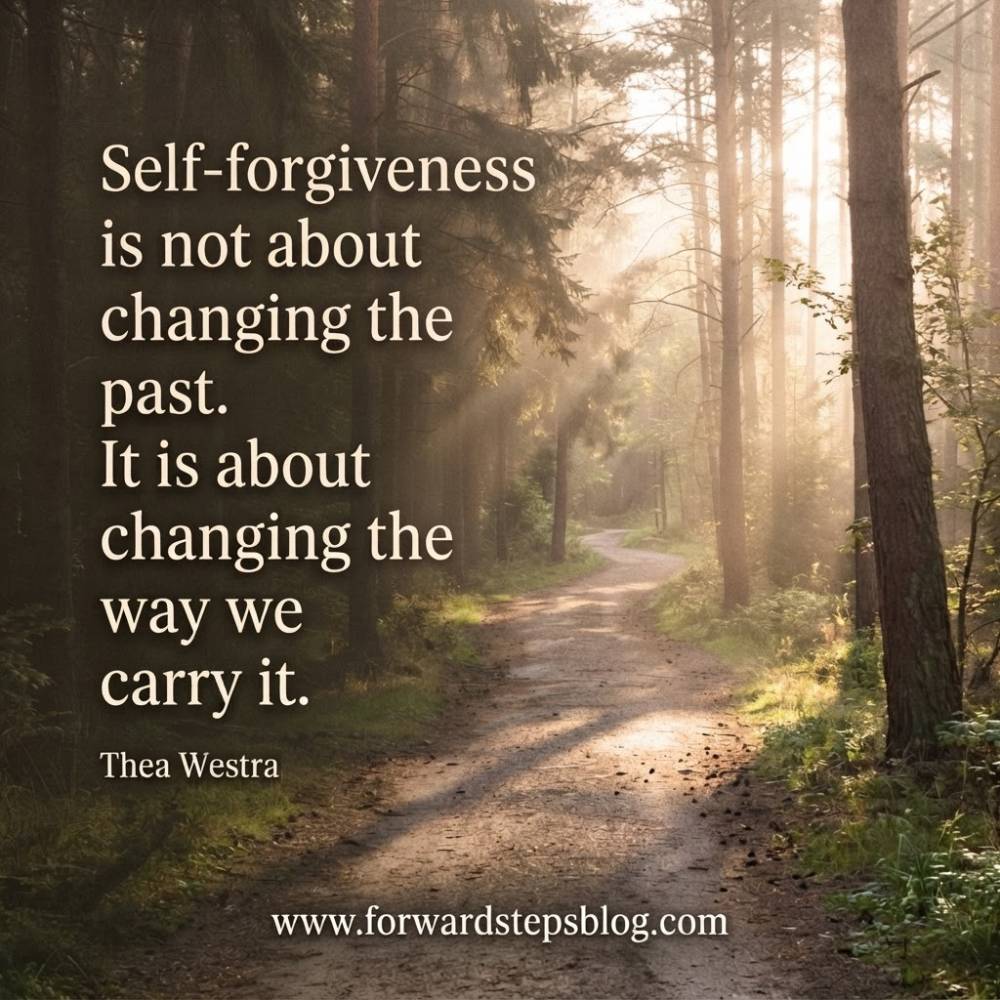 Before we can forgive ourselves, we need to be willing to look at the part of our story that still needs our kindness.
The first step is always awareness and a willingness to “be” with “what is”. Only through acceptance of every part of us can we be open to making changes and taking on a new “way of being”, refreshing how we interpret the events in our life.
This doesn’t mean that we have to uncover every painful memory or analyse every reaction.
Sometimes, a simple question is enough to begin.
“What am I feeling right now?”
“What has this situation reminded me of?”
“Is my reaction about what is happening today or is something older being stirred up?”
“Is there something I need to forgive myself for?”
“Is there a belief about myself that I am ready to question?”
We don’t need to have all the answers immediately.
We can simply become more curious about our inner workings.
Once we are in touch with our inner workings and can see the source of our ‘automatic reactions’ (as opposed to our more conscious responses), we’ll know exactly where we need to be doing our work.
What We Resist Persists
There is a saying that “what we resist, persists”.
While it isn’t a universal law, there is something useful in the idea.
When we continually push away an uncomfortable thought or feeling, it may remain unresolved. When we refuse to acknowledge something that matters to us, it can continue to influence our choices and reactions.
For example, if we believe that we are not good enough, we may pay more attention to experiences that seem to confirm that belief.
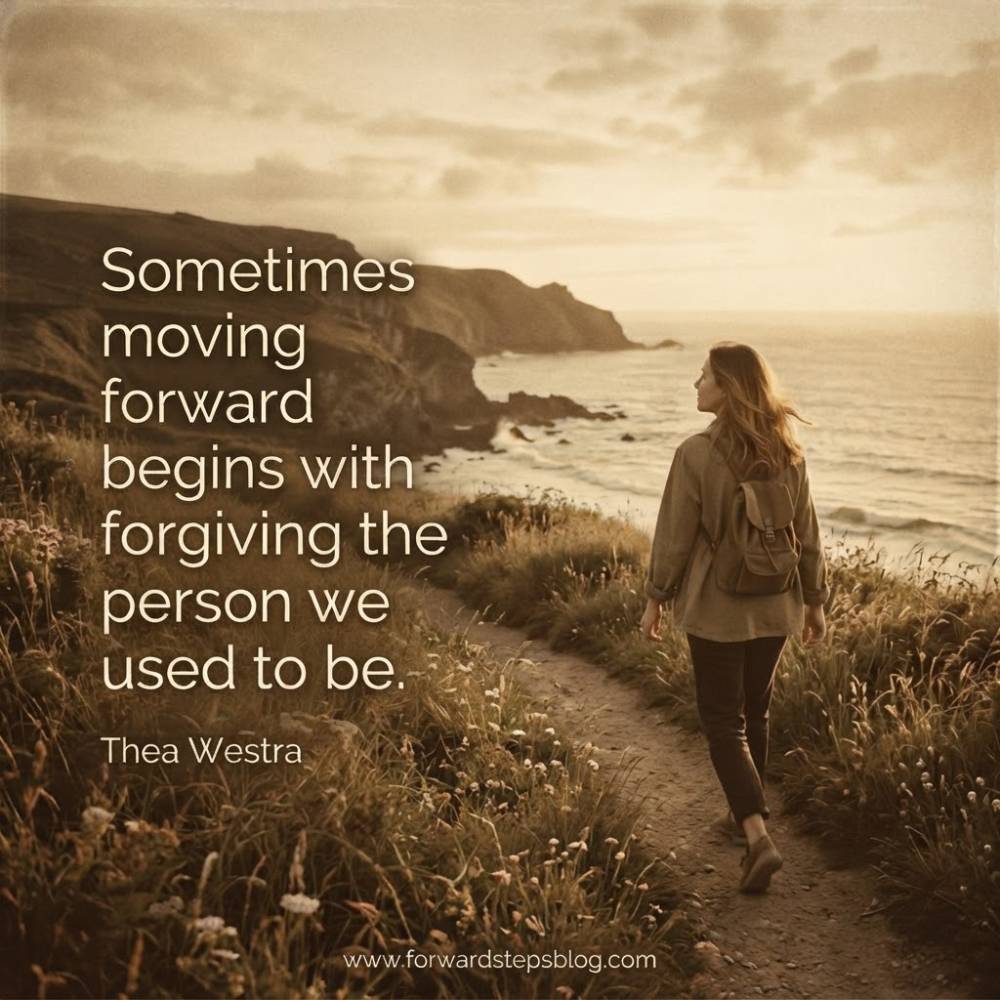 We continue to “collect more evidence” for what we believe to be true! So, if our belief is one that does not support our goals, we can entrench and compound that belief until it feels like an absolute truth and we begin to think that it cannot be any other way. This can keep us stuck or have us spinning our wheels in the sand!
If we believe that people cannot be trusted, we may become especially alert to signs of disappointment.
If we believe that we must always be perfect, a small mistake may feel much bigger than it really is.
Our beliefs can influence what we notice, how we interpret events and how we respond.
The good news is that a belief is not necessarily a fact.
A familiar reaction is not necessarily the only response available to us.
We can learn to pause.
We can question.
We can choose differently.
A Little Clearing Of The Way
Once we do become aware of something that needs a bit of work (something that wants forgiveness or clearing) and we shove it aside, then it can keep popping up for us until we deal with it.
We can push it aside and hope it disappears.
We can take responsibility for who we were without allowing our past to decide who we become. Share on XOr we can gently acknowledge it and ask what it needs from us.
Perhaps it needs forgiveness.
Perhaps it needs acceptance.
Perhaps it needs a conversation, an apology or a new boundary.
Perhaps it needs us to stop carrying responsibility for something that was never ours to carry.
There are many approaches that people find helpful when working through emotional patterns.
One of the tools I love to use is tapping.
You may find it helpful to learn more about Thought Field Therapy® and see how it works.
Get the free guide at (ad) Thought Field Therapy® and learn how it’s done.
I would recommend getting yourself a copy of (ad) Feelings Buried Alive Never Die, as well.
Your Forward Step Today
Think of someone you admire.
What is it about them that you admire so much?
Now think of someone who irritates you.
What is it about their behaviour that you find difficult?
Ask yourself:
“Is there something here that reminds me of my past?”
“Is there a quality I would like to develop in myself?”
“Is there something I need to forgive myself for?”
Not everything that triggers us is about us. Yet every reaction gives us an opportunity to know ourselves better. Share on XPerhaps the answer is simply that this person behaves in a way that doesn’t suit me and I need to honour that.
Either way, you have learned something.
You have become a little more aware.
Awareness gives us the opportunity to choose our next step.
Are you willing to let go of the thoughts, situations, people and actions that are keeping you where you are?
Perhaps today is a good day to begin.
One small step at a time.
What Might Your Emotional Reactions Be Showing You?
8 questions. Reflect on what your reactions, memories and feelings may be inviting you to understand.
Awareness Seeker
You are naturally drawn towards understanding what is happening inside you. When something triggers a strong reaction, your instinct is to pause, identify the feeling and become curious about what may be underneath it.
Your strength is your willingness to look honestly at your inner world. Awareness does not require you to uncover everything at once. Sometimes simply recognising an old reaction is enough to create a little more choice about what you do next.
If this reflection has given you something to think about, you may enjoy returning to the article and trying some of the questions there as a simple way to become more aware of what you are carrying.
If you'd like to explore yourself a little further, you might enjoy these 20 Self-Exploration Exercises.
Pattern & Reflection Seeker
You naturally look for connections between present experiences and the patterns that have shaped you. You may be particularly interested in why certain people, behaviours or situations affect you more strongly than others.
Your strength is your willingness to learn from your experiences. When a reaction keeps appearing, you can use curiosity rather than self-criticism to ask what it may be showing you and whether an old pattern is still relevant today.
If this reflection has given you something to think about, you may enjoy returning to the article and trying some of the questions there as a simple way to understand yourself more deeply.
If you'd like to explore yourself a little further, you might enjoy these 20 Self-Exploration Exercises.
Self-Forgiveness Seeker
You are particularly aware of the way past mistakes, regrets or old feelings can continue to influence the present. You may sense that some part of your history still needs understanding rather than more punishment.
Your strength is your willingness to take responsibility while recognising that responsibility and self-punishment are not the same thing. Forgiving yourself does not erase what happened. It allows you to learn from it without requiring yourself to carry the pain forever.
If this reflection has given you something to think about, you may enjoy returning to the article and considering which part of your own story may be ready for a little more kindness.
If you'd like to explore yourself a little further, you might enjoy these 20 Self-Exploration Exercises.
Letting-Go Seeker
You are most drawn towards the possibility of loosening your grip on old thoughts, beliefs, situations or stories that may no longer need to control your life. You recognise that moving forward sometimes means choosing a different response rather than continuing to replay the past.
Your strength is your willingness to make room for something new. Letting go does not mean pretending that something never happened. It means deciding that what happened does not have to determine everything that happens next.
If this reflection has given you something to think about, you may enjoy returning to the article and considering what you might be willing to release or see differently.
If you'd like to explore yourself a little further, you might enjoy these 20 Self-Exploration Exercises.
Healthy Boundaries Seeker
You understand that not every strong reaction is simply something inside you that needs fixing. Sometimes another person's behaviour genuinely crosses a line, and recognising that distinction is an important part of looking after yourself.
Your strength is your ability to combine self-reflection with self-respect. You can ask what a situation is bringing up for you while still recognising that healthy boundaries may sometimes be the most appropriate response.
If this reflection has given you something to think about, you may enjoy returning to the article and considering where greater understanding, acceptance or a clearer boundary might help you move forward.
If you'd like to explore yourself a little further, you might enjoy these 20 Self-Exploration Exercises.
Explore This Idea Further
Optional prompts to help you make the ideas your own.
I use AI as a thinking companion, not as a replacement for my own thinking. These prompts are simply another way to explore the ideas in this article and see how they might apply to your own life.
You don’t have to use AI to benefit from them. You can copy a prompt into a notebook, write about it in your journal, talk it through with someone you trust or simply sit with the question and see what comes up for you. If you do use ChatGPT or another AI tool, treat its responses as a starting point for your own thinking.
You remain the person who decides what is useful and right for your life.
How to use these prompts: Choose the one that appeals to you, copy the complete prompt and paste it into ChatGPT or another AI tool. You can answer its questions and continue the conversation as you go.
1. Apply This To My Life
Use this prompt when you want to connect the article’s ideas about buried feelings with something happening in your own life.
I’ve just read the Forward Steps article “Feelings Buried Alive Never Die.” Use that article as your primary source and foundation for this conversation. Help me understand how its ideas about buried feelings, strong reactions, past experiences, old beliefs, self forgiveness and becoming more aware of what may be influencing me could apply to something I am experiencing in my life right now.
Ask me a few thoughtful questions first if you need more information. Then help me consider whether something from my past may be influencing the way I am reacting to a person, relationship, situation or event today, and what I might learn from becoming more aware of it.
Do not assume that every strong reaction is caused by something buried in my past or that I am to blame for what I am feeling. Help me distinguish between what the article suggests I may need to look at within myself and what may genuinely belong to the situation or another person.
Build on my answers and give me thoughtful, practical and personalised guidance while staying closely grounded in what the Forward Steps article teaches.
2. Reflect More Deeply
Use this prompt when you want to look more closely at what your feelings and reactions might be showing you.
I’ve just read the Forward Steps article “Feelings Buried Alive Never Die.” Use that article as your primary source and foundation for our reflection. Help me look more deeply at the connection between my feelings, my reactions and experiences from my past without assuming that every feeling has a hidden explanation.
Guide me through a thoughtful conversation rather than giving me a long list of questions all at once. Ask me useful questions about a reaction, relationship, situation, old belief or past experience that I choose to discuss. Help me consider what may be beneath my immediate response, what I may be holding onto, whether I am judging myself or someone else through an old lens and whether there is something I could understand, accept or forgive.
Help me notice patterns, assumptions or possibilities I may not have considered, while keeping the reflection grounded in the article’s message. Do not diagnose me, overanalyse my feelings or turn the conversation into generic psychological advice.
Respond thoughtfully to my answers and build on what I tell you. Help me arrive at my own insights rather than telling me what I should think.
3. Turn It Into Action
Use this prompt when you are ready to turn an insight about your feelings into one practical next step.
I’ve just read the Forward Steps article “Feelings Buried Alive Never Die.” Use that article as your primary source and foundation for helping me turn one useful idea from it into practical action.
First help me identify what feels most relevant to my life right now. Ask me a few thoughtful questions if needed. Then help me choose one feeling, reaction, old belief, past experience or relationship situation that may be worth looking at more closely.
Based on what I tell you and what the article teaches, help me decide on one or two realistic actions. These might involve becoming more aware of what I am feeling, questioning an old belief, acknowledging something I have been holding onto, forgiving myself or someone else, changing the way I respond or having a conversation that may help me move forward.
Keep the plan simple and manageable rather than giving me a long list of things to do. Build on my answers, help me choose a clear first step and encourage progress rather than perfection. Do not invent techniques or advice that are unrelated to the article. Keep the article’s message at the centre of the plan.
Tip: You don’t have to use all three. Start with the one that feels most useful to you right now.

Hi, I'm Thea Westra at Forward Steps (forwardstepsblog.com)
CLICK HERE To Trigger More Of Those Forward Steps 'Aha' Light Bulb Moments!