

Everybody quietly carries a philosophy of life. It might be scribbled in a journal or hidden behind habit and routine. The challenge is this, most of us live by default rather than design.
We drift into assumptions, inherit other people’s beliefs, then we wonder why our choices feel hollow.
 If you want something richer than that, it helps to build a personal philosophy you can actually live by. The following takes you into how to do it, practical, down to earth and no fluffy veneers.
Why you need your own philosophy
If you never pause to ask “What do I stand for?” you’ll borrow from others without realising it. A personal philosophy acts as your internal compass. It’s a way to measure decisions, respond to setbacks and wake each day with less friction.
Without your own philosophy you may find your values dissolve under peer pressure, commercial seduction or simply the tides of habit.
When you live by someone else’s map you may still arrive somewhere, yet it won’t always feel like you’ve chosen the destination.
The right question can reveal a lifetime’s worth of values. Share on XBy forming your own philosophy you say, “Here’s how I look at the world. Here’s how I want to act. Here’s the pattern I’ll follow”. That doesn’t eliminate hardship or confusion, it gives you a stable platform when things wobble.
Research into personal philosophies emphasises this, a clear set of beliefs and values can align your thinking and action. (see full insight (ref) here)
 Your philosophy becomes a filter through which you sort opportunities, relationships and challenges.
Start by noticing what already drives you
You’ve lived years already. Some things matter more than others. Begin by paying attention.
What choices did you make when you were scared or pressed? What made you stay or walk away? What actions brought you regret and which brought you pride? These clues indicate the building blocks of your underlying philosophy.
This isn’t about grand introspection in a mountaintop retreat. It can be as simple as asking, “When I faced that awkward conversation did I shrink, fight or walk away? Why? When I chose to say yes to that job did I do it for money, status, meaning?”
You’re not judging yourself harshly, you’re just collecting information about you.
Live as if someone will quote you one day. Share on XOne writer refers to a “theory – attitude – principle – behaviour” chain. Your beliefs weave into attitude, that shapes your guiding principles which then translates into behaviour. (read the full idea (ref) here)
Indeed, by noticing what already drives you you begin to articulate your tacit philosophy.
Define your core values and non-negotiables
Now you move from observation into selection. Values are the raw materials of your philosophy. Choose 3 or 5 that feel foundational. Too many and they dilute. Too vague and they don’t act as useful anchors.
 For example, you might settle on, integrity, curiosity, care for others, practicality and freedom. Then ask, “What does each mean in my world?”
Integrity might mean being honest with my partner even when it costs me. Curiosity might mean trying something new every month. Care for others might mean making time for a friend and showing up even when tired.
Make it specific enough so that in a slippery moment you recognise, “If I act this way I honour value X. If I don’t I’m betraying it”. That clarity is what gives values power.
The exercise of studying your values and reflecting on them is a common step in personal philosophy work. (explored in depth (ref) here)
Write out your belief statements
With values clear you now craft belief statements. These are short sentences or phrases that capture how you view the world and how you intend to engage with it. They might begin, “I believe…” “I value…” “I commit to…”
When you lose direction, return to your values. Share on XA few examples include:
I believe that every person deserves respect, even when I disagree.
I value choosing reality over comfort, facing truth rather than hiding.
I believe that integrity matters most when no one is watching.
I value presence over performance, showing up fully instead of perfectly.
I believe in choosing action over hesitation, even when the path is uncertain.
I value simplicity, because clarity hides inside it.
 I believe that kindness without expectation is a quiet form of strength.
I value consistency more than intensity, small steps done daily shape a life.
I believe that freedom grows from discipline, not escape.
I value curiosity over judgment because every story has more than one layer.
I believe that peace is built, not found.
I value truth spoken gently more than silence kept safely.
I commit to learning something new, even when I feel it’s too late.
I believe that caring for my health is a gift to my future self and those I love.
Write them down. Read them aloud. See if they land as true for you, not idealised, not what you wish you were, however what you are willing to stand behind. Good belief statements don’t freeze you. They guide you. Refinement is part of the process.
You live better when your words and your actions shake hands. Share on XOne source calls this “writing down your operating manual” for decision-making. (as shared (ref) here)
Translate your philosophy into decision filters
A philosophy that lives in a notebook but not in your daily life is just decoration. You must build the connection between belief and behaviour. That means turning belief statements into decision filters or question prompts.
For example, when you’re offered a chance to work long hours for prestige ask, “Does this honour my value of freedom and care for my partner?” If yes, proceed. If no, skip.
When choosing a holiday ask, “Does this meet my commitment to learning something new?” If yes, go. If no, consider another.
 Life throws curveballs, you’ll still have to decide when tired, distracted or under pressure. If you’ve pre-built the questions you can lean on your philosophy rather than impulse.
This approach matches what writers say about effective philosophies, they become filters for action. (summed up (ref) here)
Expect refinement not perfection
Let’s get realistic, you won’t nail it straight away. Your personal philosophy will evolve. At 20 you might emphasise risk and freedom, at 40 you emphasise nurture and security. That’s perfectly okay.
One framework says the process of refining your life philosophy should take decades, “There are no final answers, just slightly better ones”. (worth reading (ref) here)
The trick is to run faster than resistance, not wait for perfect clarity.
A personal philosophy isn’t a rulebook, it’s a reminder. Share on XWhen you find yourself acting in ways that feel off, that’s your philosopher’s signal, “Hey, wake up. We have something to adjust”. Rather than beating yourself, view it as calibration. Your self-philosophy is a work in progress, not a stone tablet.
Use story and memory to ground your philosophy
Philosophy isn’t simply abstract statements. It becomes alive when anchored in your real story. Pick 2 or 3 key memories that illustrate your values in action.
Some examples of these might be:
 The time you stood up for someone when it was unpopular.
The project you abandoned because it felt wrong even though the money was good.
The moment you realised a relationship was draining because you weren’t caring for yourself.
Write them down. These stories give guts to your philosophy. When your values feel distant you can hold the memory, feel the texture, remember what it costs not to live your creed.
Memory turns belief into embodied truth. It reminds you that you already lived your philosophy once and that you can again.
Embed daily rituals that reflect your compass
Big claims need small practices. If you say you believe curiosity matters then schedule time for something new. If you say care for others matters then commit to one real engagement each week. If integrity matters then carve out reflective time at day’s end.
Your actions show others your creed, whether you say it or not. Share on XRituals don’t have to be majestic or long. A 10-minute journal entry on “today I honoured my value of honesty by…” is valid. A check-in with your partner about “what mattered today” is valid. A walk alone with no phone is valid.
These small acts erect a bridge between philosophy and life. Without them your philosophy remains theory. With them it becomes habit. You’re building muscle memory for choices aligned with your beliefs.
Prepare for resistance and adjust anyway
Living by your philosophy isn’t always smooth. You’ll face conflict, other people’s expectations, old habits, convenience, fatigue. When you feel resistant you’ll wonder, “Why bother?” That’s an ideal moment to lean into your philosophy.
 One practical tactic, when you dread the choice, ask yourself, “What would I regret if I did the easier thing instead of living this value?”
Regret is a powerful indicator. Much regret comes from what we didn’t do rather than what we did. Contrast aligning with your philosophy often feels uncomfortable but alive.
Also, guard against dogma. Your philosophy shouldn’t be a rigid cage that traps you. It should be a compass that guides you yet allows responsiveness when life evolves. You hold the philosophy, not it holding you.
Review, revise and live it continuously
Every quarter or so pause and review if you are still aligned. Are the values still true? Are the rituals still working? What parts feel stale? What stories no longer resonate? What new ones might matter?
Write a short note to future you, “What I believed six months ago vs what I believe now”. This keeps your philosophy fresh. Evolution doesn’t mean abandonment. Instead it means deeper alignment.
Your philosophy should fit your life, not someone else’s. Share on XEventually you’ll reach a point where you don’t constantly think about your philosophy, it becomes default. You’ll act from the inside out rather than outside in. That is living your philosophy.
Building a personal philosophy you can live means saying yes to clarity and no to autopilot. It means noticing what drives you, defining what you stand for, writing it out, turning it into filters and rituals, anchoring it in story and refining it over time.
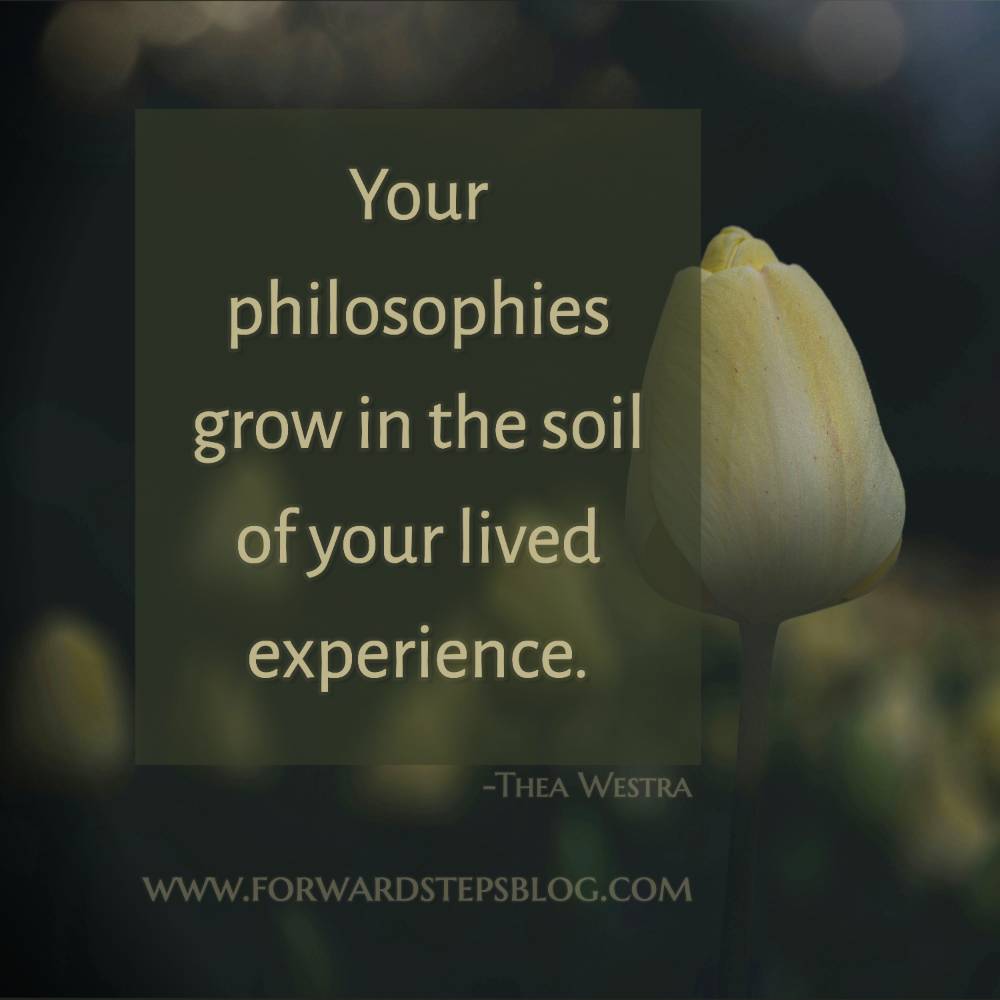 The process isn’t perfect or painless. It’s honest. It is yours.
When you live by your own philosophy you don’t just drift, you steer. You won’t avoid all storms however you’ll hold the helm with a hand you trust.
When your beliefs and your actions finally match, life feels lighter and far more meaningful.
Clarity doesn’t arrive in a thunderclap, it grows each time you choose what matters over what’s easy.
You don’t need to overhaul everything overnight, just begin living one value more fully today.
Wisdom is the ability to act in line with your philosophy under pressure. Share on XThat’s how a personal philosophy stops being words on a page and starts becoming the life you actually live.
PLUS check out these free gifts from friends… CHECK out the following great resources as well…Forward Steps Personal Development »

Hi, I'm Thea Westra at Forward Steps (forwardstepsblog.com)
CLICK HERE To Trigger More Of Those Forward Steps 'Aha' Light Bulb Moments!