

Self-talk is one of the most powerful methods of changing your life.
Quite simply, it’s the most direct method of upgrading the programs your brain uses to run your life.
This short story hints a little at just how powerful your own mind is.
The story of Two Frogs
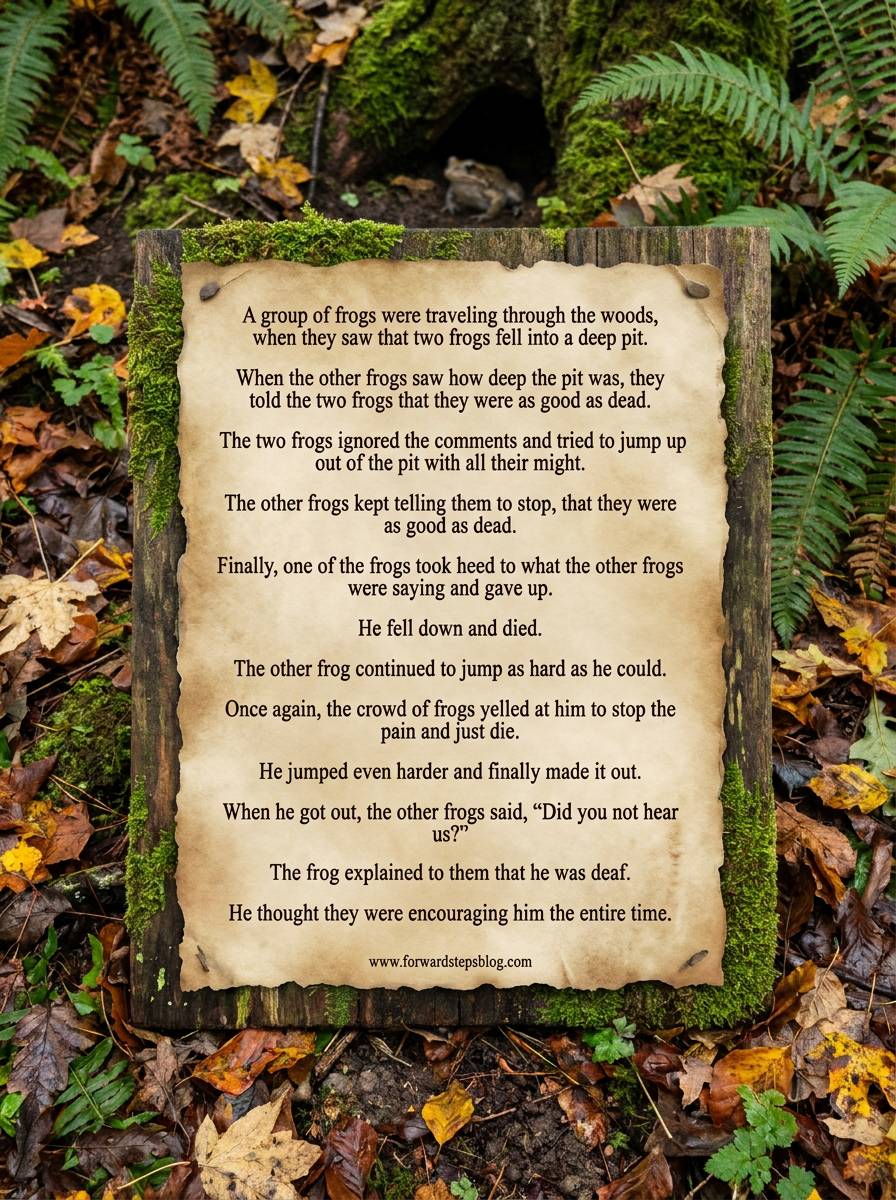
A group of frogs were traveling through the woods, when they saw that two frogs fell into a deep pit.
 When the other frogs saw how deep the pit was, they told the two frogs that they were as good as dead.
The two frogs ignored the comments and tried to jump up out of the pit with all their might.
The other frogs kept telling them to stop, that they were as good as dead.
Finally, one of the frogs took heed to what the other frogs were saying and gave up.
He fell down and died.
The other frog continued to jump as hard as he could.
Once again, the crowd of frogs yelled at him to stop the pain and just die.
He jumped even harder and finally made it out.
When he got out, the other frogs said, “Did you not hear us?”
The frog explained to them that he was deaf.
He thought they were encouraging him the entire time.
Share and download the Two Frogs story
Click on the image for your sharing buttons. Below this image is a link to the PDF that you’re welcome to save and share too.
Download your PDF of this story, here
This story teaches two lessons
1. There is power of life and death in the tongue.
An encouraging word to someone who is down can lift them up and help them make it through the day.
2. A destructive word to someone who is down can be what it takes to kill them.
Be careful of what you say. Speak life to those who cross your path. Share on XThe power of words… it is sometimes hard to understand that an encouraging word can go such a long way.
Anyone can speak words that tend to rob another of the spirit to continue in difficult times.
Special is the individual who will take the time to encourage another.
 Since the day you were born, you’ve had all sorts of “programming” entering your brain.
I’m talking about information and commands, either coming from yourself or from the outside world (through your five senses).
The self-talk shaping your life
This “programming” is known as your self-talk.
In other words, commands and programs that your brain has “recorded” and which are played back, over and over.
These are programs which have ultimately shaped your life and they’re not always positive.
You know the type of (ad) self-talk I’m talking about.
The self-talk which says you just aren’t good enough. You can’t lose weight. You’re not worthy. You don’t deserve true love. You’ll never be a success.
Special is the individual who will take the time to encourage another. Share on XThe kind of self-talk that says you’re too stupid. You’re not lucky enough. You’ll never be that confident. You’ll never achieve your greatest goals. You’ll never be wonderfully healthy. You’ll never find your own happiness.
The worst part is that most people don’t even realize that their self-talk is negative!
You see, the brain doesn’t distinguish between “good” and “bad” commands. It simply accepts the self-talk and uses it to shape your ultimate destiny.
There’s not a doubt about it.
Everything you are today is the result of your (ad) self-talk.
Explore This Idea Further
Optional prompts to help you make the ideas your own.
I use AI as a thinking companion, not as a replacement for my own thinking. These prompts are simply another way to explore the ideas in this article and see how they might apply to your own life.
You don’t have to use AI to benefit from them. You can copy a prompt into a notebook, write about it in your journal, talk it through with someone you trust or simply sit with the question and see what comes up for you. If you do use ChatGPT or another AI tool, treat its responses as a starting point for your own thinking. You remain the person who decides what is useful and right for your life.
How to use these prompts: Choose the one that appeals to you, copy the complete prompt and paste it into ChatGPT or another AI tool. You can answer its questions and continue the conversation as you go.
1. Apply This To My Life
Use this prompt when you want to connect the article’s ideas about encouragement, discouragement and the power of words with something happening in your own life.
I’ve just read the Forward Steps article “Two Frogs With 2 Encouraging Lessons.” Use that article as your primary source and foundation for this conversation. Help me discover where its message about the power of encouraging or destructive words, the influence of other people’s words and the effect of my own self talk may be relevant in my life right now.
Start by asking me a few thoughtful questions about a situation, relationship, challenge or pattern where this message might apply. Then, based on my answers and the article, help me see what I may be telling myself or receiving from others and how I could respond more constructively.
Keep your guidance grounded in the article rather than giving me generic self improvement advice. Continue the conversation by building on my answers rather than giving me one large response and stopping.
2. Reflect More Deeply
Use this prompt when you want to look more deeply at how words and self talk may be influencing the way you experience your life.
I’ve just read the Forward Steps article “Two Frogs With 2 Encouraging Lessons.” Use that article as your primary source and foundation for our reflection. Help me look more deeply at its message about how words can either encourage someone to keep going or discourage them from continuing, and how self talk can become part of the way I see my life.
Ask me a few thoughtful questions that help me notice patterns, assumptions or possibilities I may have overlooked. In particular, help me consider whose words I tend to listen to, what I regularly say to myself and whether I might sometimes underestimate the effect my own words have on myself or others.
Respond thoughtfully to my answers and keep exploring with me. Stay grounded in the actual lessons of the article and do not turn this into a generic psychological exercise.
3. Turn It Into Action
Use this prompt when you are ready to turn the article’s encouraging message into one or two practical changes you can make.
I’ve just read the Forward Steps article “Two Frogs With 2 Encouraging Lessons.” Use that article as your primary source and foundation for developing my next steps. Help me turn its message about encouraging words, destructive words and the power of self talk into one or two practical changes I can make in my life.
First, help me identify which part of the article feels most relevant to me right now, asking a few questions if you need more information. Then suggest a small number of realistic actions I could take, such as changing how I speak to myself, being more encouraging toward someone who is struggling or becoming more careful about which discouraging messages I allow to influence me.
Help me choose what feels most useful and turn it into a simple plan I can actually follow. Keep the focus on progress rather than perfection, and build the plan from the article’s message rather than adding unrelated self improvement techniques.
Tip: You don’t have to use all three. Start with the one that feels most useful to you right now.

Hi, I'm Thea Westra at Forward Steps (forwardstepsblog.com)
CLICK HERE To Trigger More Of Those Forward Steps 'Aha' Light Bulb Moments!
